Does Andrea Bocceli Want to See Again
What's a young blind Italian student to do when his beautiful blond crush, Mary, approaches?
Well, if a slew of new assistive technologies now being developed at MIT and Northeastern come to fruition, the intimate interaction might unfold like this: the blind student, wearing a cutting-edge device — a smart jacket, for instance — equipped to communicate a complex array of information privately to a blind user, volition be able to sense Mary's presence, facial expressions and body linguistic communication, chat intelligently with her about literature and movement in to clasp her mitt when a rival suitor approaches.
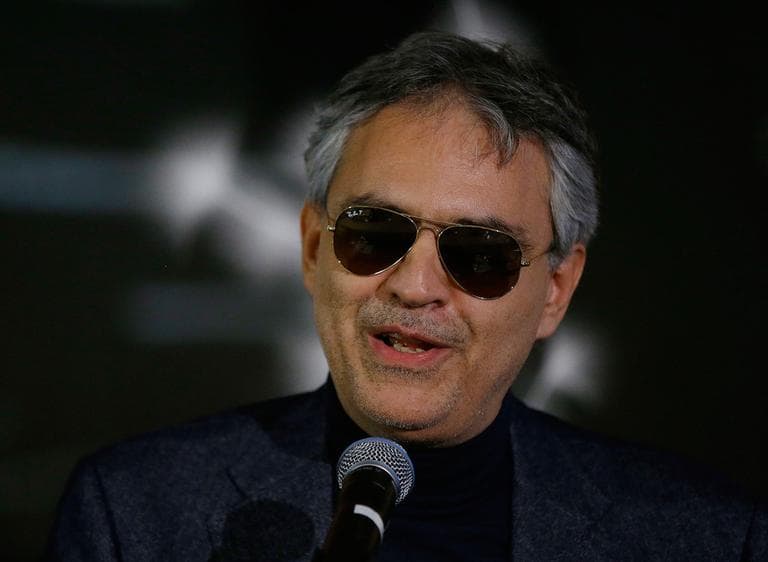
The characters hither are fictional, of form. But the overarching ambitions of this research, funded by the bullheaded Italian opera superstar Andrea Bocelli's foundation, are both intimate and far-reaching. "The thought was a huge bet," Bocelli said today. He was speaking through a translator at a workshop at MIT to introduce the array of new technologies to empower bullheaded people to live, study and work more than independently. "To create a tool, a device, that would basically substitute itself for the eyes." He characterized the research every bit going from the "impossible to the possible."
The genesis of the Bocelli-MIT venture was a mail-concert meeting in Boston several years agone, Bocelli said. He brainstormed with several MIT professors to discover out what kind of technology for the blind would "exist possible." Since then, a collaborative team of cross-disciplinary researchers take developed prototypes that may anytime be able to deliver disquisitional data to the blind: everything from dynamic information about safe walking terrain and hazards, to enhancing social interactions in existent-time through wearable devices or a vibrating watch with a high-resolution tactile display that tin can deliver important information through the peel.
"I have to be honest, the idea of this project was non born of my ain needs — I am in a privileged situation," with an entourage of helpers all around, said Bocelli, who grew up with depression vision and so became completely bullheaded in childhood following a sports-related accident. But "there are many people, some of them my friends, that are living lone in a metropolis, and they have the issue of going to work on their ain, going grocery shopping, locating the items on the shelves...The issue is really living on one's own." Speaking at a news conference, Bocelli conceded that one day, he might apply the technology himself: "Of course, when it will come to fruition, it will be helpful to me as well — because the main problem is that humanity has people who are never happy with what they have. This technology will be helpful first for people who are on their ain, but then it will come in handy for people similar me, who want to exist on their ain some times."
Specifically, The Andrea Bocelli Foundation says it'due south given about $500,000 to fund researchers at MIT, and Northeastern to develop these technologies.
A central endeavor is called The 5th Sense Project (seeking to supersede the missing sense of sight)
and involves a squad of researchers led by Seth Teller, a professor of computer science and engineering in the EECS department, and a principal investigator) in the Computer science and Artificial Intelligence Lab. (For full disclosure, see beneath.)
The team is developing wearable devices for blind and depression-vision people that "combine sensing, computation and interaction to provide the wearer with timely, chore-appropriate information about the surroundings — the kind of information that sighted people get from their visual systems, typically without witting effort," Teller said.
1 of Teller's graduate students, David Hayden, is working on what he calls a "socially acceptable" wearable associate recognizer, or assistant, that provides feedback well-nigh nearby people through audio, tactile and other modes. Hayden explained: "It's continuously watching for anyone you know. The device will try to identify the people in your life. A lot of slap-up conversations start at the water cooler, but blind people can't initiate them."
Another project would identify and read text — say, on appliances, which have become less accessible to blind people as they've moved from knobs to smartscreens.
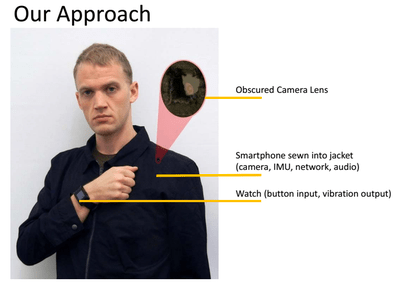
The 5th Sense Project, still in its early phase, focuses on several areas:
1. Safe Mobility And Navigation
Imagine walking effectually the city of Boston with your eyes closed. Kind of scary, right? This applied science tries to go at some really critical questions about safely getting around in the world, for instance, where are the appropriate walking surfaces and how can bullheaded people avoid tripping and collision hazards? Ultimately the device might be able to reply more than specific questions, like: Where am I? Which fashion is it to my destination? When is the next turn, landmark or other salient environmental attribute coming upwardly? Do my surround include text, and if so what is information technology? Where is the kiosk, concierge desk, elevator entrance hall, water fountain, for instance, that I seek? What transit options (passenger vehicle, taxi, train, etc.) are nearby or arriving?
2. Detecting And Identifying People
Social interactions are, manifestly, essential for a full life.
For the bullheaded, information technology's not so easy to initiate these kinds of interactions, and so this technology aims to, for instance, let users know when friends, strangers or acquaintances are approaching (similar fictional gorgeous Mary on the Italian campus) and who they are; what is their body stance and body language; what are they wearing?
3. How To Convey Information Non-Visually Through Tactile And Aural Interfaces
The key question here is: How can the system effectively engage in spoken dialogue with the blind or visually dumb person so that he or she can specify goals or needs or desires?
Plainly, there are already technologies out there to assist the blind. The American Federation for the Blind identifies two categories: general items, like computers, smartphones and GPS devices, and more personally tailored devices, including "everything from screen readers for blind individuals or screen magnifiers for depression-vision calculator users, devices for reading and writing with depression vision, to braille watches and braille printers."
Others have personalized devices even further, like vizwiz's iPhone app that allows bullheaded people to receive quick answers almost their surroundings from sighted spider web volunteers who answer questions submitted over the Internet.
Merely the MIT squad's wearable device project is more aggressive: somewhen the applied science should work in real-time, they say, and support both mobility and social functions without sacrificing privacy.
"Why develop assistive technology for bullheaded people?" Teller said in prepared remarks. "The unemployment rate for blind people is estimated at 75 percent in the United States, and approaches 100 per centum in many parts of the developing world. Access to educational activity is a key bulwark; many bullheaded and visually impaired children are simply left behind, unable to access the materials needed for their studies, specially in the areas of scientific discipline, engineering and technoogy..."
Hither's more from Teller on why this research is important:
Think most basic mobility, the ability to move safely and independently from point A to signal B, which is a primal aspect of developed life and employment. Yet blind people are unaware of imminent obstacles and trip hazards. Fifty-fifty with a long cane they must move slowly through unfamiliar environments, or accept sighted assistance, to stay safe.
Or consider social information, the awareness of what other people are nearby and what they are doing. This is again a key aspect of a participatory life, to which bullheaded people accept fundamentally less access than sighted people. Here blindness changes the bones nature of social interaction, from proactive to reactive, from fluid to halting, from independent to dependent.
Finally consider environmental data, awareness of the text and symbols that are everywhere in our environs, used to discover 1's way, to locate personal objects, to shop, to identify resources, to operate electronics and appliances, to reach the myriad tasks involved in living an independent life. Again, this kind of environmental data, with rare exceptions, is simply not available to blind people. And the problem is getting worse as more and more appliances are designed with visual touchscreens inaccessible to blind people.
So at its heart, we are tackling a trouble of admission: how can we develop machines that tin can capture and interpret this kind of information and relay it to a blind user, rapidly enough to be useful in a dynamic world? This trouble is clearly securely compelling from a technical perspective, every bit information technology involves the nature of visual information in natural and congenital environments, and algorithms for chop-chop sensing, interpreting and delivering such information. Only it's also a problem of compelling social interest, every bit its solution volition level the playing field for tens to hundreds of millions of people around the world not just in instruction and employment, but in social and personal pursuits...
In the United States, for example, despite the great number of congenitally blind and visually impaired people, and the growing number of people losing vision through disease or normal aging processes, there is proportionally little funding available to support assistive technology development for visual function.
"One might expect that with the wars of the last decade, and the many thousands of veterans returning domicile without vision, major public resource would accept been allocated to alleviating their disability, but this is simply non the case...
Bocelli, the renowned, Pisa-born tenor who, co-ordinate to news reports, is "the biggest-selling artist in the history of classical music" with nearly 100 million albums sold, said he's pleased to accept sparked this flurry of research. Low-cardinal, wearing dark sunglasses and encircled by his Italian minders, Bocelli was asked if he'd be sporting a wearable device or vibrating spotter someday in the future. He paused for a second, shrugged and, reverting to English language replied: "Why not?"
(Here'southward the total disclosure: Seth Teller is my husband. I normally never write virtually his work,but Bocelli'southward star ability made information technology a news story today. And no pretense of objectivity here: I think what he and his colleagues are attempting is very absurd.)
Source: https://www.wbur.org/news/2013/12/06/blind-opera-superstar-andrea-bocelli-seeks-high-tech-vision-at-mit
0 Response to "Does Andrea Bocceli Want to See Again"
Post a Comment